A French pin can make putting your hair up feel like part of getting dressed: a small finishing detail with a lovely shape of its own. The satisfying part is finding an arrangement that holds without constant checking. Start with the hair you have, the bundle you want to secure and a pin that feels comfortable in your hand.
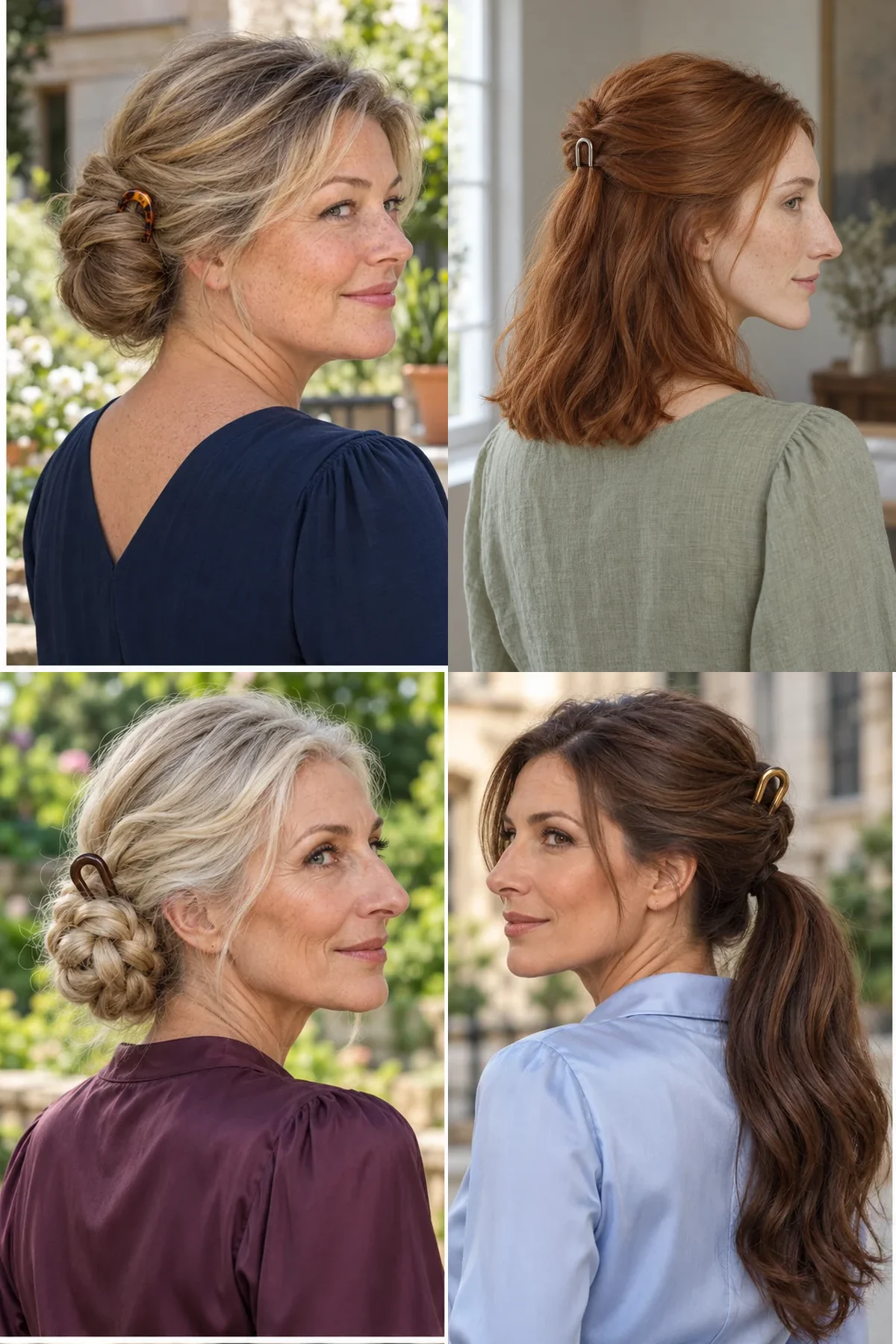
A French hair pin is usually a rigid U-shaped accessory with two long prongs that help anchor a folded or coiled section of hair. It is different from a small bobby pin, which grips a narrow section, and from a claw clip, which closes around a bundle. French pin hairstyles are the arrangements held with that accessory; they do not all have to be upright French twists. These eight ideas compare different constructions, including half-up folds, knots and a braided coil. The photographs show finished shapes, not insertion diagrams: practice the fastening separately, and use discreet extra support whenever your hair needs it.
Find the one that feels like you: Start with the first look and let the photographs lead. Each style explains how the shape affects your features, the mood it creates and the exact words to take to your stylist.
Quick Facts
- A U-shaped pin needs to engage the foundation, not just the outside of the style.
- Half-up arrangements can be useful when short layers will not reach a full updo.
- Pin length and curve should suit your bundle and feel comfortable.
- One pin is not a promise: extra discreet support is entirely reasonable.
1. The Classic Fold With a Visible Pin
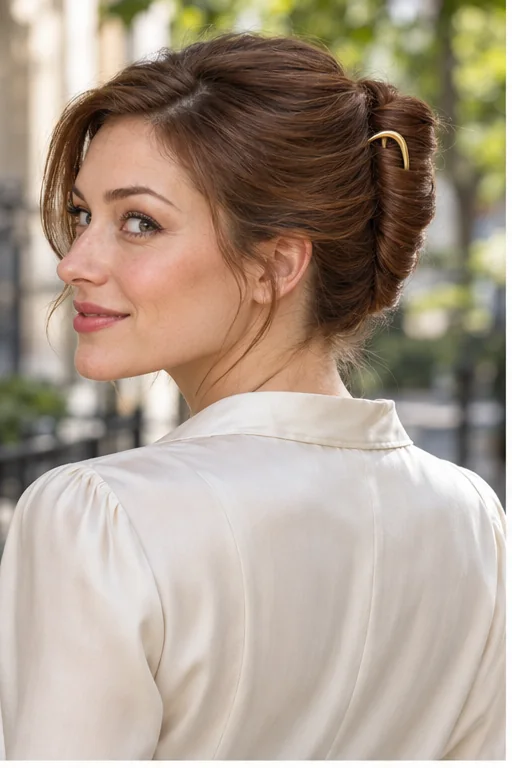
An upright fold gives this chestnut updo its clean outline, while a small gold pin marks the seam without taking over the whole hairstyle. Clearing the neck and keeping the sides close creates a composed, dressed-for-the-day feeling, especially when you want an alternative to a large clip above your collar. It suits lengths that can fold inward comfortably; very long ends need arranging inside the roll rather than being squeezed into a bulky pocket. Ask your stylist for a compact vertical fold with tucked ends, then have them demonstrate how your own pin catches the foundation and where hidden support would help.
Ask your stylist for: A compact upright roll, tucked ends and a visible U-shaped pin with a securely anchored foundation.
2. A Low Coil That Sits Above the Collar
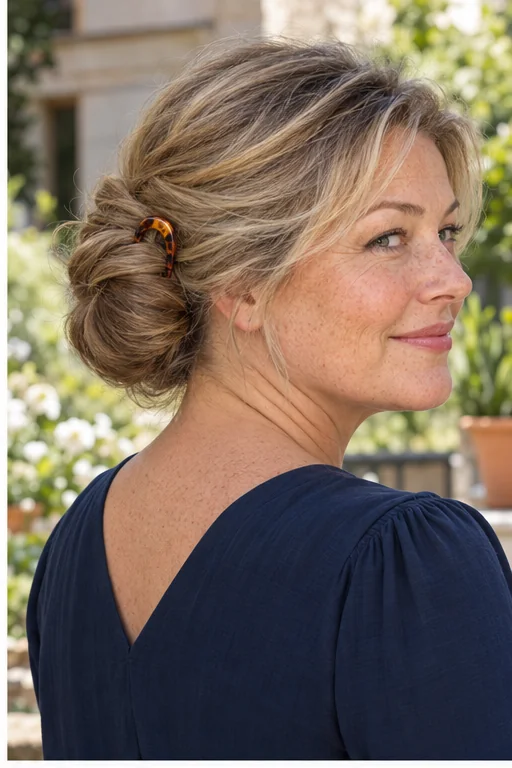
Rather than folding upward, this version winds the length into a low, rounded coil with a tortoiseshell pin crossing its outer edge. The contained shape leaves the crown quiet and the neckline clear, which can feel reassuringly polished for work without adding much height to your silhouette. Choose it when your ends are long enough to wrap and tuck; a loose tail that keeps escaping is a reason to adjust the construction, not twist harder. Bring the collar you plan to wear and ask for a low coil that clears it, with the pin engaging the base and any necessary extra support hidden underneath.
Ask your stylist for: A low coiled bun just above my collar, with tucked ends and a French pin anchored through the base.
Pause and notice: The pin should hold the foundation, not merely decorate the outside. A beautiful shape that swivels needs its anchor reset.
3. The Half-Up Fold With Loose Lengths
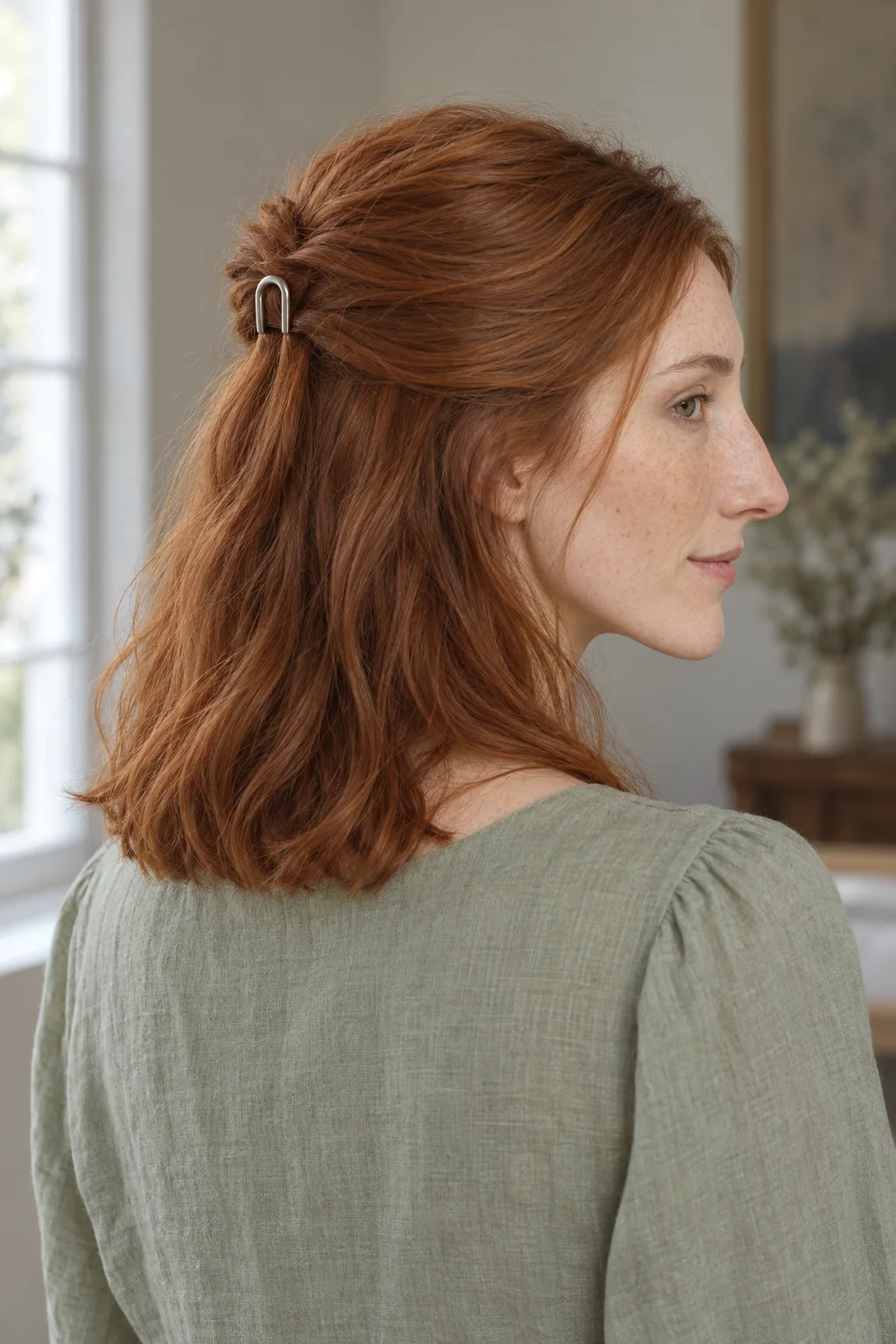
If putting all your hair up feels like too much of a change, a small folded twist gives you a gentler starting point. The upper section turns inward beneath a silver pin while the lower lengths stay loose, keeping familiar movement around your shoulders and taking the top strands away from your eyes. That balance can feel relaxed and quietly pretty on an ordinary afternoon, particularly with a layered cut that cannot reach one full updo. Ask for a half-up fold made only from sections that meet comfortably, and choose a smaller pin for that smaller bundle so its ends do not overwhelm the shape.
Ask your stylist for: A small half-up folded twist with loose lower lengths and a pin scaled to the gathered section.
4. A Half-Up Knot Above Soft Curls
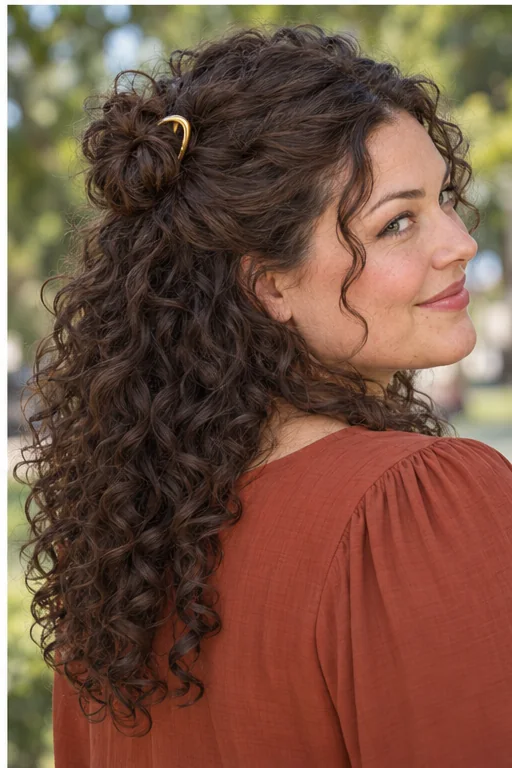
Here the gathered upper hair wraps into a small round knot instead of a flat fold, leaving dark curls free beneath it. The raised shape adds a playful focal point while preserving the texture and shoulder coverage you enjoy when your hair is down, so the change feels expressive rather than formal. It is a useful option when the top section has enough length to coil without stretching the curls tightly against the scalp. Tell your stylist you want a small half-up knot with the lower curl groups left intact, and check the pin's hold before loosening surface pieces so you do not accidentally release the foundation.
Ask your stylist for: A small rounded half-up knot, defined curls left loose below and a gently anchored French pin.
Pause and notice: Half-up does not mean halfway finished. A smaller gathered section can be the most comfortable and realistic choice for your length.
5. A Braided Coil With a Textured Edge
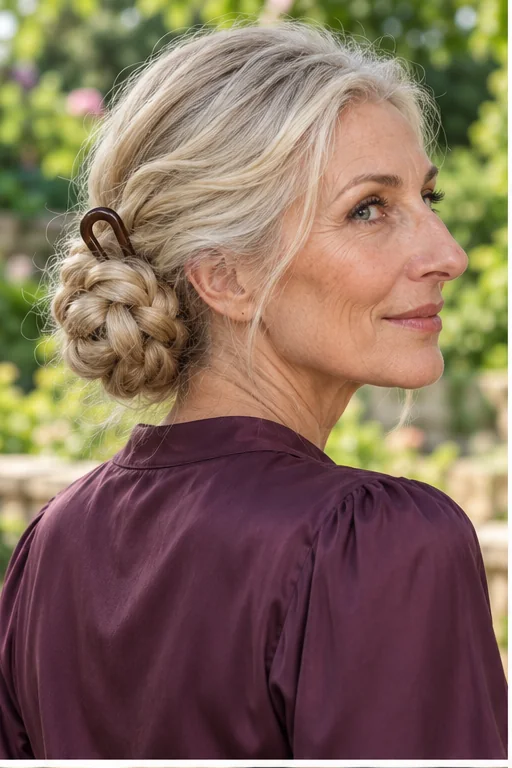
A simple braid wound around its base gives this low bun a woven outline that stays interesting even with very little decoration. The visible crossings make the arrangement feel considered and a little romantic, offering texture for an occasion without requiring a large cloud of teased hair. Longer lengths usually give you more room to braid and coil, although density will decide how substantial the finished shape looks. Ask for a loosely formed three-strand braid wrapped into a low coil, with the ends tucked and the pin anchored beyond the braid into the foundation; pinning only through the outer woven edge can leave the whole bun able to swivel.
Ask your stylist for: A simple three-strand braid coiled low, with the woven edges visible and the French pin anchored beyond the braid into the base.
6. Two Small Buns, Each With Its Own Pin
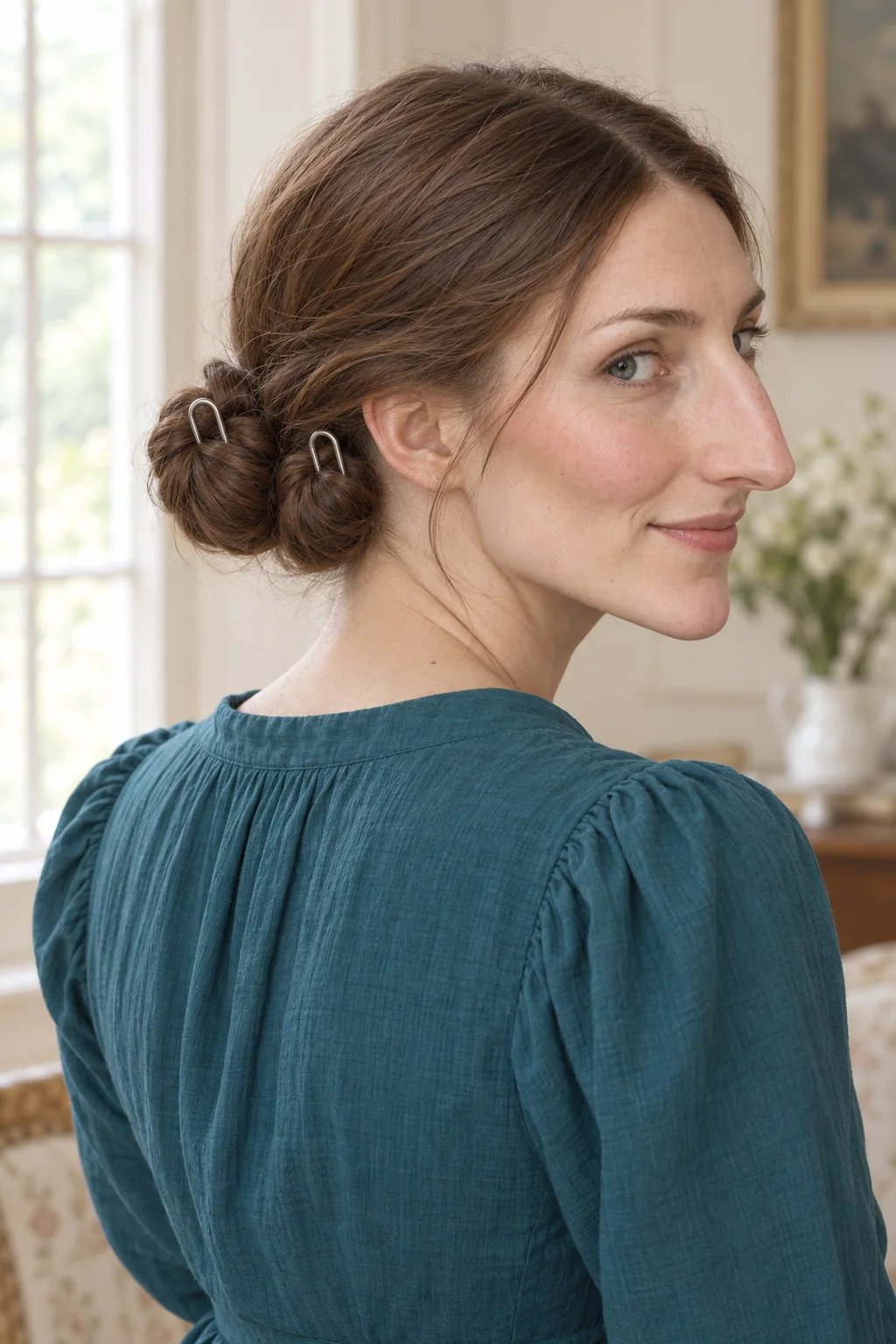
Two small coils sit side by side near the nape, with a separate silver pin securing each one. Dividing the hair changes the silhouette completely and lets you work with smaller bundles, a practical experiment when one large arrangement is awkward to hold while you insert a pin. The paired shapes feel playful and intentional, especially with a simple neckline, although they still need enough length to wrap without tugging across the center part. Ask for two low coiled buns with comfortable spacing and a pin for each foundation, then check both sides independently; matching accessories do not mean the two bundles will need exactly the same adjustment.
Ask your stylist for: Two separate low coiled buns, with one small French pin securing each foundation and no pulling across the center part.
Pause and notice: Choose the number of supports your hair needs. A discreet extra pin is more useful than spending the afternoon checking a slipping style.
7. A Twist That Releases Into a Ponytail
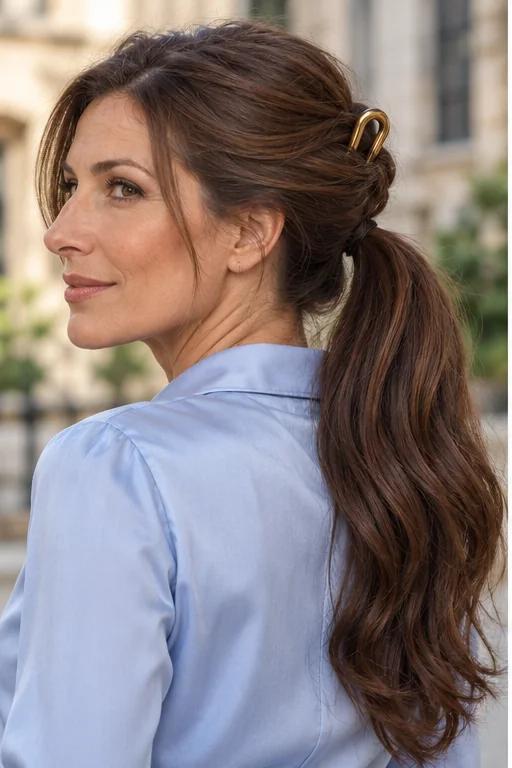
This arrangement keeps a short twisted fold at the back but lets the remaining length fall into a ponytail beneath it. You get the clean sides of an updo and the swing of loose hair together, which can feel lively and dressed up without hiding the length you have worked to grow. It asks more of the anchor than a fully tucked roll, because the hanging tail moves, so practice and discreet extra support may be worthwhile. Show your stylist a short pinned twist with an intentionally released ponytail, and ask them to check the hold during gentle head movement rather than promising that one decorative pin will do everything.
Ask your stylist for: A short pinned twist with the remaining length released as a ponytail, adding discreet support if my hair slips.
8. The High Knot With a Clean Neckline
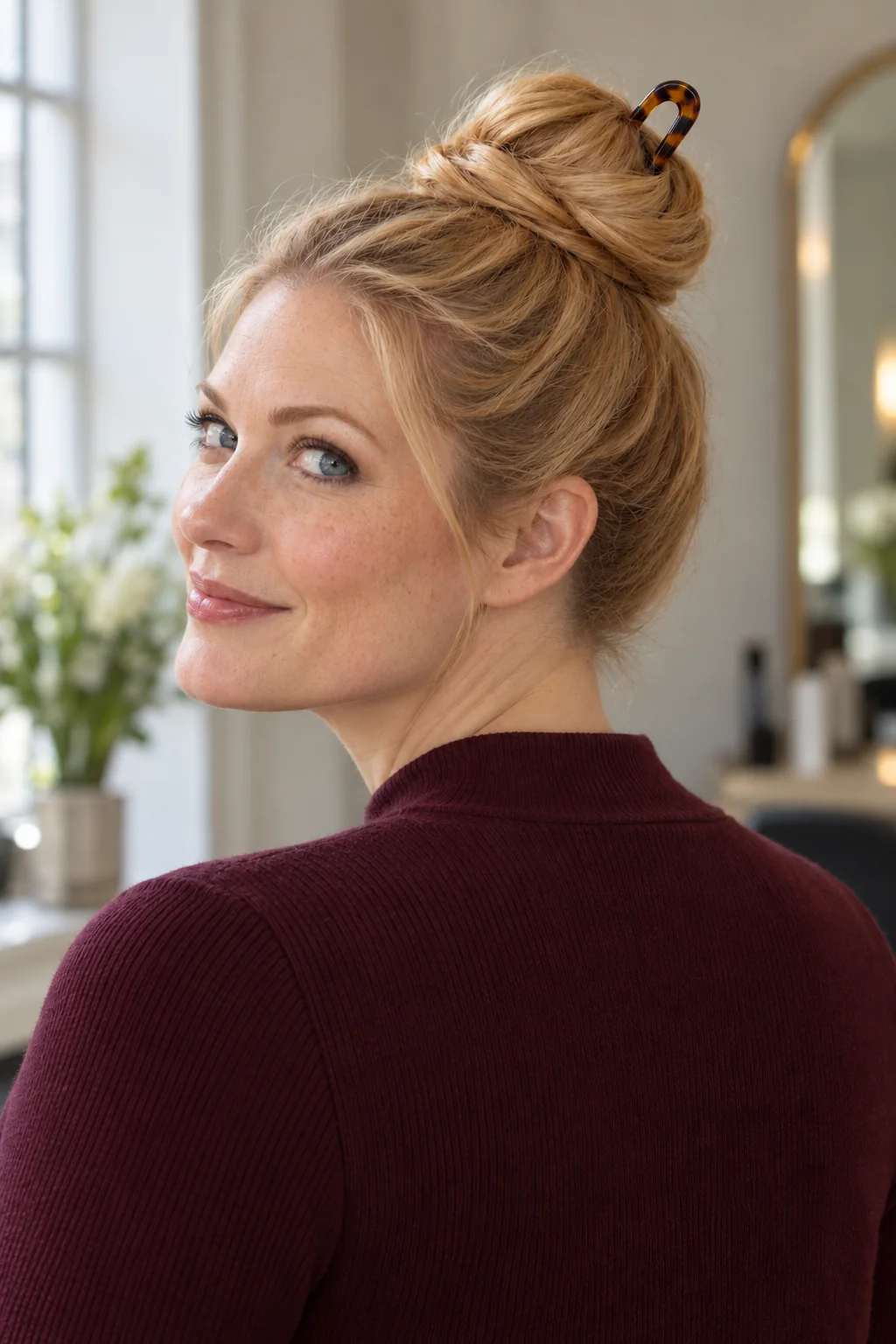
Moving the coil high on the head creates a much taller outline and leaves the entire neck clear. A tortoiseshell pin adds a small finishing detail to the warm blonde knot, while the open sides can make the style feel fresh and energetic with a scarf or higher neckline. It works when the nape sections can reach the chosen position comfortably; shorter layers may need a lower placement rather than more tension. Ask for a high coiled knot with tucked ends and softly controlled sides, then test whether the pin presses when you move your head, resetting the anchor or changing the pin if the arrangement feels uncomfortable.
Ask your stylist for: A high coiled knot with comfortable sides, tucked ends and a French pin that does not press against my head.
Before You Book the Appointment
A successful salon visit begins with the overall shape, construction and upkeep—not only the finished length. Use this quick reality check before choosing your final reference photograph.
- Fine strands or lower density: Try a smaller bundle and appropriately sized pin; a very large fork can protrude or slide. Fine strands and low density are different concerns.
- Thick or long hair: Check that the usable prong length can engage the foundation. Split the hair into smaller arrangements or add support rather than forcing an overloaded pin.
- Waves and curls: Preserve the groups you want to see and gather them gently. A textured surface does not remove the need for a secure anchor.
- Short hair or layers: A half-up style may be more realistic than a full bun. The gathered section needs enough length to fold and secure without pulling.
- Daily routine: Practice while you have time to reset. Test comfortable movement before relying on a new fastening for an event.
Choose the Pin for the Bundle
French pins vary in length, curve, thickness and surface finish. A pin that works in a large bun may project too far from a small half-up fold, while a short pin may fail to engage the foundation of a substantial coil. Try the accessory with the actual section you intend to secure. The bridge may remain visible as decoration, but exposed tips should not poke or catch. Choose smooth, intact edges and stop using a pin that snags. There is no single size that holds every density or length.
Understand the Anchor Before Chasing the Finish
First form a fold or coil you can hold comfortably with one hand. A common fastening approach catches a small amount of the outer section, turns the pin and brings its prongs back through the arrangement toward the foundation. The exact direction depends on the style and the pin's curve; watch a demonstration with your own accessory instead of pushing blindly. Keep the points away from your scalp, and never force them through a resistant bundle. Ask your stylist to show the movement slowly, including removal, before you rely on it alone.
If Your French Pin Keeps Slipping
Check the structure before adding more product. A pin can slide because it is too large for the gathered section, too short to reach the base, or traveling only through the outer shell. Rebuild a smaller, more controlled bundle and try a different position or pin. Very slippery hair may benefit from a small amount of a suitable styling product, following its directions, but grip does not replace anchoring. Use discreet bobby pins or another support when needed. If the arrangement pulls, presses or feels unstable, take it down and reset rather than tightening it repeatedly.
Short Hair, Curls and Growing Layers
A short cut may not supply enough length for a full coil, even when a photograph looks compact. Try the half-up fold using sections that meet without pulling, and leave the rest loose. Curls can be gathered in their existing groups for a textured finish; avoid brushing them smooth unless that is the result you want. As layers grow, the same pin may work with a larger section, so revisit the construction rather than assuming you need a different haircut. These are temporary arrangements and do not require a particular grow-out plan.
A Useful Salon Request and a Comfortable Finish
Bring your pin and describe the construction, placement and amount of loose hair: for example, a small half-up fold at the back with the lower lengths left down. Explain your density, slipping problems and how much practice you want to do at home. Ask which extra supports are holding the foundation so you can remove them safely. Before leaving, turn your head gently and check the style against your collar. Take every support out before separating the hair, then loosen the fold or coil gently instead of pulling the pin through a tangled section.
Watch the Fastening in Motion
A finished portrait helps you compare shapes, but an insertion demonstration makes the hand movement easier to understand. Alex Gaboury's French-pin tutorial demonstrates a roll, half-up fold and bun; ghd also shows French-pin styling. Use the linked demonstrations as a starting point and adapt with your stylist when your own pin or texture behaves differently.
The Takeaway
Start with the shape you would enjoy wearing tomorrow: loose lengths beneath a fold, a quiet low coil or a knot that clears your collar. Then practice the anchor with a pin suited to that amount of hair. When the arrangement feels comfortable and stays where you placed it, the accessory can become the lovely finishing detail you wanted in the first place.
More Hair Inspiration
- French Twist Hairstyles — Compare upright roll shapes if the classic fold is your favorite.
- Minimalist Bun Hairstyles — Explore restrained bun placement and finish.
- French Pin Fastening Demonstration — Watch the fastening movement for three different constructions.
- ghd French Pin Styling Guide — See another demonstration of French-pin styling.